
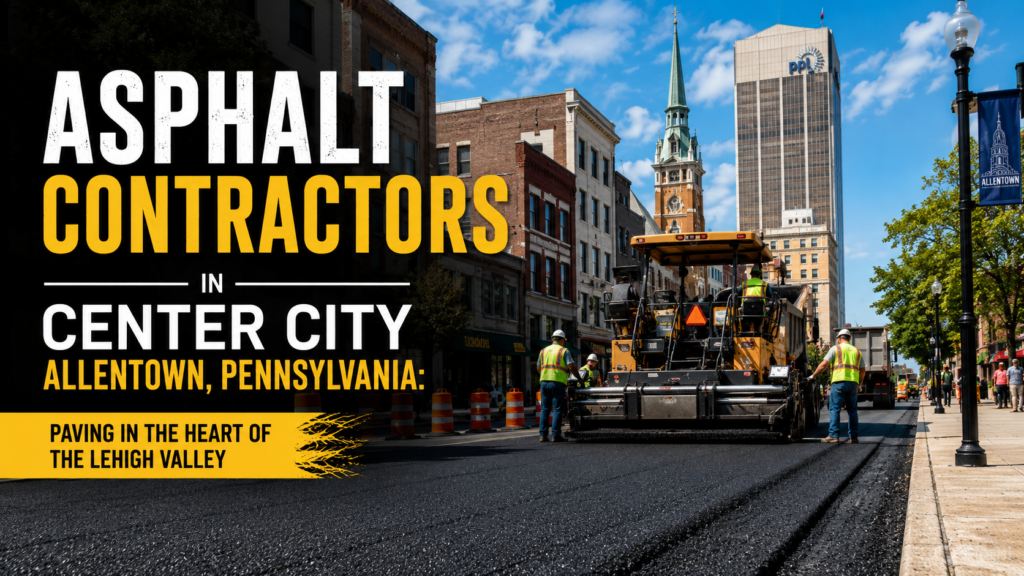
Center City Allentown is the historic downtown core of Pennsylvania third-largest city and the economic, civic, and cultural nucleus of the Lehigh Valley. Stretching roughly from 4th Street to 12th Street between Walnut and Linden Streets, Center City encompasses the city central business district, government buildings, the PPL Center arena at 7th and Hamilton Streets, major employers including PPL Corporation, One City Center, and Two City Center, and a mix of residential development ranging from Victorian rowhouses to modern high-rise apartment buildings in converted historic structures. After decades of post-industrial economic challenge, Center City Allentown is experiencing a genuine renaissance driven by the Neighborhood Improvement Zone (NIZ), a 2009 state-designated tax incentive district that has catalyzed more than a billion dollars in downtown investment. This revitalization context makes Center City one of the most active and consequential markets for Asphalt Contractor Center City paving services in all of Lehigh County.
The NIZ and Its Impact on Paving Demand in Center City
The Neighborhood Improvement Zone, which covers approximately 128 acres in Center City and the city riverfront district, has fundamentally transformed the physical landscape of downtown Allentown over the past decade. The construction of PPL Center, new office buildings, residential conversions of historic structures, streetscape improvements, and the revitalization of Hamilton Street as a pedestrian-friendly commercial and entertainment corridor have all generated significant demand for professional pavement work. Parking facilities associated with new developments, access roads and loading areas for new commercial properties, and the comprehensive Hamilton Street Streetscape project which replaced broken pavement and upgraded the 1.5-mile corridor from 5th through 12th Streets all required the skills of professional asphalt contractors.
The Hamilton Street Streetscape project, developed through a partnership between the Allentown Neighborhood Improvement Zone Development Authority (ANIZDA), the City of Allentown, and developer City Center Allentown, is a particularly notable example of urban paving at scale in the NIZ context. This transformation replaced decades-old deteriorated pavement, removed 112 unhealthy trees that were replaced with 185 new plantings, installed modern lighting, and created a sustainable, pedestrian-friendly corridor that now anchors Center City commercial activity.
What Asphalt Contractors Provide in Center City
Asphalt contractors working in Center City Allentown serve a dense, urban environment with a mix of commercial, institutional, and residential properties at varying stages of development and maintenance need. Core services in this context include:
- Commercial parking lot installation and maintenance: New commercial developments in the NIZ and surrounding Center City area require parking infrastructure built to appropriate commercial specifications. Existing parking facilities throughout the district require systematic maintenance including sealcoating, crack sealing, pothole repair, and periodic restriping.
- Access road and loading area paving: Commercial and institutional properties require properly surfaced access roads, delivery areas, and service corridors. In Center City dense urban fabric, these are often compact, technically demanding paving environments.
- Asphalt milling and overlay: For existing paved surfaces throughout the district that are beyond the effectiveness of surface maintenance but have structurally sound bases, milling and overlay extends service life at significantly lower cost and disruption than full-depth replacement.
- ADA compliance improvements: Center City commercial properties are subject to federal ADA and Pennsylvania accessibility requirements. Parking facilities must provide appropriately configured accessible spaces, properly sloped and surfaced accessible routes, and required signage. Asphalt resurfacing projects trigger ADA review requirements.
- Crack filling and sealcoating: Preventive maintenance treatments that protect existing asphalt from the Lehigh Valley freeze-thaw cycling that is the dominant pavement deterioration mechanism in Central Pennsylvania.
- Emergency pothole repair: In urban commercial environments where customer access and safety are immediate concerns, prompt pothole repair is a business-critical service.
The Lehigh Valley Climate and Center City Pavement
Allentown and the Lehigh Valley experience a humid continental climate that creates demanding conditions for asphalt pavement. Average annual precipitation of approximately 44 to 46 inches falls throughout the year. Winter temperatures regularly drop below freezing, and the area experiences an average of approximately 40 freeze-thaw cycles per year days when temperatures cross the 32-degree threshold. This cycling is the primary enemy of asphalt in the Lehigh Valley:
Water infiltrates any surface crack. When temperatures fall below freezing, that water expands by approximately 9 percent enough to mechanically widen cracks with each freeze cycle. Over successive winters, unchecked freeze-thaw damage transforms minor surface cracking into structural base failure that cannot be corrected by surface treatment alone.
In Center City Allentown, where the urban heat island effect from dense commercial development can create localized temperature differentials, and where road salt applications to maintain pedestrian and vehicle safety are routine in winter, these deterioration mechanisms are particularly active. Salt accelerates moisture infiltration into asphalt cracks and introduces chloride ions that contribute to binder degradation and reinforcing element corrosion in concrete-adjacent structures.
Paving in an Urban Historic Context
Center City Allentown contains three distinct historic districts Old Allentown, Old Fairgrounds, and West Park and much of the downtown corridor is subject to oversight from the City Historical Architectural Review Board (HARB). While asphalt paving and parking lot maintenance work does not typically trigger historic review, site work adjacent to historic structures requires awareness of property line boundaries, drainage patterns affecting historic structures, and access management that avoids damage to historic facades and foundations during equipment operation.
Allentown Center City also contains a significant inventory of buildings with Art Deco architectural character the city PPL Building and the Dime Savings and Trust Company building are examples that reflect the commercial prosperity of the 1920s and 1930s. Commercial properties adjacent to these historic structures have parking and access road maintenance needs that require contractors comfortable working in architecturally sensitive environments.
Commercial Property ADA Compliance in Center City
For commercial properties throughout Center City Allentown, ADA compliance in parking facilities is both a legal obligation and a practical business necessity. The Americans with Disabilities Act requires that commercial parking facilities provide a minimum number of accessible spaces scaled to total lot size, that accessible spaces meet dimensional requirements (minimum 8 feet wide for standard spaces, 8 feet wide with an 8-foot access aisle or 11 feet wide with a 5-foot aisle for van-accessible spaces), that accessible spaces and their access aisles not exceed a 2 percent slope in any direction, and that appropriate signage be provided.
Pennsylvania also has state-level accessibility requirements that may add to or clarify federal ADA standards. Any significant asphalt resurfacing, repair, or reconfiguration project at a Center City commercial property should include an ADA compliance review as part of the project scope. Experienced asphalt contractors working in commercial environments in the Lehigh Valley incorporate this review as a standard element of commercial project planning.
Pavement Management for Center City Property Owners
Property owners and managers in Center City Allentown particularly those whose properties have benefited from NIZ investment and the downtown revitalization that has followed have strong incentives to maintain their pavement in excellent condition. A well-maintained parking lot or access road reinforces the investment made in building renovations and commercial improvements. Deteriorated pavement adjacent to renovated facades and streetscape improvements creates a jarring visual contrast and signals maintenance neglect.
Proactive pavement management for Center City properties includes annual condition assessment, crack sealing before each winter season, sealcoating on a 2 to 3 year cycle, prompt pothole and structural repair, and coordination of larger overlay or replacement projects during the period that minimizes disruption to tenants and customers. For properties with multiple tenants or high-visibility commercial frontage, scheduling major paving work during lower-traffic periods evenings, weekends, or holiday periods for office buildings reduces business disruption.
Pennsylvania Contractor Requirements
Asphalt contractors performing commercial paving work in Center City Allentown above defined thresholds must hold a Pennsylvania contractor license. Pennsylvania licensing requirements for construction contractors include the need for appropriate business registration, tax compliance, and for certain regulated activities, specific contractor certification. Property owners and facilities managers planning significant paving projects should verify contractor credentials and confirm that the contractor carries appropriate general liability and workers compensation insurance before authorizing work.
Conclusion
Asphalt contractors in Center City Allentown serve a downtown corridor that is actively regenerating after decades of post-industrial challenge. The NIZ-driven revitalization, the pedestrian-scaled streetscape improvements of Hamilton Street, and the new commercial and residential development throughout the district all create both opportunity and obligation for professional pavement maintenance and construction. Understanding what asphalt contractors provide, how the Lehigh Valley climate affects pavement, and what ADA requirements govern commercial facilities gives Center City property owners the context to maintain their pavement assets in a manner consistent with the quality of the downtown renaissance they are part of.